How Healthcare Environmental Services Have Changed Over the Last 50 Years
Originally published October 26, 2026 on johnmichaelweir.com.
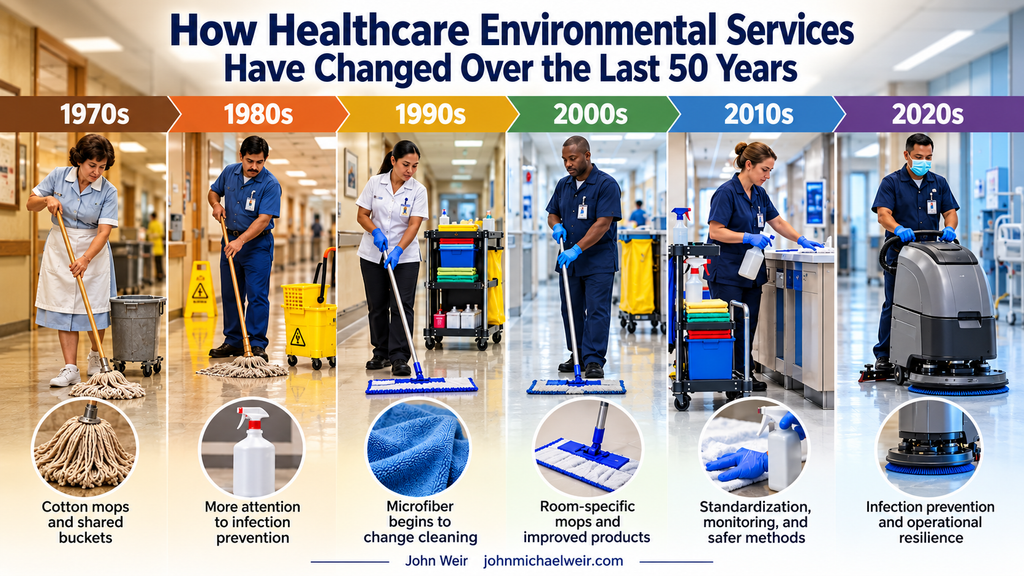
Healthcare environmental services have evolved from labor-intensive cleaning routines into specialized, evidence-informed programs designed to reduce infection risks, protect staff, and use resources more efficiently. Advances in cleaning materials, disinfectants, equipment, safety practices, and infection prevention have reshaped how hospitals and other care facilities maintain their environments.
1970s: Traditional tools and routines
In the 1970s, environmental services teams commonly used cotton string mops and shared buckets of water and cleaning solution. As a mop moved from room to room, its water could become increasingly soiled, potentially spreading dirt and microorganisms rather than removing them effectively. Cotton towels were also widely used for surface cleaning and were laundered for reuse.
Disinfection often relied on products with relatively long label contact times. A surface might need to remain visibly wet for as long as 10 minutes, making it difficult to ensure that the required time was achieved during routine work.
Carpet cleaning products could contain high levels of volatile organic compounds (VOCs). Cleaning methods often involved more moisture, which could mean longer drying times and greater disruption to care areas.
1980s: Greater attention to infection prevention
Growing awareness of healthcare-associated infections led facilities to give more attention to cleaning procedures, staff training, and the separation of clean and dirty supplies. Written protocols began to formalize how rooms, restrooms, and frequently touched surfaces should be cleaned.
Some facilities introduced more controlled systems for preparing and distributing cleaning solutions. These measures helped improve consistency, though traditional cotton mops and reusable towels remained common.
1990s: Microfiber begins to change cleaning
Microfiber cloths and mops became increasingly available. Their fine fibers could capture dirt and particles effectively, while their lighter weight made them easier for staff to handle. Facilities began shifting from cotton cleaning towels toward microfiber, often using color-coding to help prevent cloths used in one area from being used in another.
Mop systems also started to move away from repeatedly dipping the same mop into shared water. Some programs adopted pre-prepared mops or systems that provided fresh cleaning solution more consistently.
2000s: Room-specific mops and improved products
The use of microfiber mops expanded, including systems that assigned a clean mop to each room or area. Using a fresh mop for each room helped reduce the risk of carrying contamination from one space to another. Disposable mop heads also became an option, particularly for isolation rooms or situations requiring additional infection-control precautions.
Disinfectant formulations and product options continued to develop. Some products offered shorter labeled wet contact times-such as three minutes or one minute-than the 10-minute times common in earlier generations. Shorter times could make it easier to meet product directions, but staff still needed to keep the surface visibly wet for the full label-specified period.
2010s: Standardization, monitoring, and safer methods
Environmental services programs increasingly used standardized procedures, checklists, and training to improve consistency. Facilities paid closer attention to high-touch surfaces and the needs of different patient-care areas. Audit methods, including fluorescent markers and other monitoring approaches, helped teams identify surfaces that were missed and target coaching.
Microfiber systems became more established, and disposable wipes and cloths were used where appropriate. These products offered a convenient way to provide a fresh cleaning material for a task, though facilities still had to select products compatible with their disinfectants and follow manufacturer instructions.
Carpet care also shifted toward lower-VOC products and low-moisture methods. These approaches could reduce odors, limit drying time, and allow areas to return to use sooner, while supporting better indoor air quality.
2020s: Infection prevention and operational resilience
The COVID-19 pandemic brought renewed attention to environmental cleaning, particularly high-touch surfaces, shared equipment, and staff training. Facilities reinforced procedures for isolation rooms, appropriate personal protective equipment, safe handling of waste and linens, and correct use of cleaning and disinfecting products.
Modern programs combine microfiber or disposable materials, clearly defined cleaning workflows, product-specific contact times, and ongoing quality checks. Equipment has also improved: ergonomic handles, lightweight carts, safer wringing systems, and automated floor-cleaning machines can reduce physical strain and support more consistent work.
Improvements in safety and sustainability
Over the past 50 years, healthcare environmental services has increasingly emphasized worker safety. Better ergonomics can help reduce repetitive-motion injuries, while training in chemical handling, personal protective equipment, and safe lifting helps protect staff. Clear labeling, dilution controls, and safer storage practices also reduce the chance of exposure or product misuse.
Sustainability has become another consideration. Facilities may reduce water use through microfiber systems and low-moisture carpet care, while choosing products with lower VOC content or using disposable materials selectively. The best approach depends on infection-prevention needs, product directions, facility policy, and environmental goals.
A more specialized role
Healthcare environmental services has changed from a largely manual cleaning function into an essential part of infection prevention and patient safety. Fresh mops for individual rooms, microfiber cloths, disposable options, shorter-contact-time disinfectants, low-VOC carpet products, improved equipment, and stronger safety programs have all contributed to that change. The tools have advanced, but the core requirement remains the same: follow evidence-based procedures and product instructions to maintain clean, safe care environments.
#EnvironmentalServices #EVS #ES #InfectionPrevention #covid19 #microfiber #safety